INTRO
In Hero Realms, each champion has unique abilities and strengths—but how do you determine which cards truly offer the best value? To provide some clarity, I compiled a list of all champions and gave each card a subjective score based on what I consider important in gameplay.
Using these criteria, I calculated a score for every card and then compared these scores to the card’s cost, resulting in a cost coefficient. Low-cost cards are slightly penalized in this system. This is intentional because a powerful high-cost card is often more valuable than multiple cheap cards with less impact.
This approach gives an objective view of each card’s efficiency, making it easy to identify which champions offer the best value for their cost.
That said, I’m not a data expert. This is the first time I’ve done a data analysis like this, but I hope you find it insightful and that it helps you decide which sets to start with and which champions to buy.
About the scoring system
This section explains how the Champion ranking system was created. Each Champion card was given a numerical score based on its effects (such as draw, gold, damage, body, sacrifice, etc). These scores are used to calculate overall value, efficiency compared to cost, and separate ratings for early game and late game impact.
The system is meant to provide a structured and consistent way to compare Champions — not a perfect or absolute judgment of their strength.
So if you’re not interested in the methodology behind the rankings, feel free to skip the next section.
The scoring system
For this champion list, I wanted to create something more than just a personal ranking based on feeling or experience. Instead, I built a structured scoring system to evaluate every Champion card in a consistent way.
All Champion cards are included in the list, along with nearly all of their relevant effects and statistics — such as draw, sacrifice, body, damage, gold generation, and cost. Each of these elements was assigned a fixed point value. The goal was to make the evaluation as uniform and objective as possible, so that every card is judged by the same standards.
For example, draw as a primary effect is worth three points, while draw as a secondary effect is worth two. The more gold a card generates, the more points it receives. Higher damage and stronger body values also increase a card’s total score. By assigning clear numerical values to these effects, I created a foundation that allows Champions to be compared directly.
That said, the system is not perfect. Not every effect in Hero Realms can be easily quantified. Some mechanics are highly situational or difficult to measure in raw numbers. For instance, I did not account for top-decking effects in the formula, which means cards like Varrick may not score as highly as their in-game impact might suggest. Because their are so many unique or special effects across the Champion pool, I added a general “extra” column. This is worth one point by default and serves as a small adjustment for abilities that don’t fit neatly into the main categories.
For that reason, the scores should always be viewed with nuance. The system is designed to provide structure and clarity — not absolute truth.
Beyond the total score, I introduced a cost coefficient. This compares a Champion’s total point value to its cost, giving a clearer picture of efficiency. In other words, it shows how much value you receive for what you pay. A Champion with a high total score may still be inefficient if the cost is too high, while a cheaper card with a slightly lower score might actually offer better value.
To make comparisons even clearer, I ranked all cost coefficients and converted them into a quality percentage. This makes it easy to see at a glance how a Champion performs relative to the rest of the list.
Finally, I created separate evaluations for the early game and the late game. Not all Champions perform equally well in every stage of the game, so weighting the effects differently helps reflect their true impact over time.
For the early game score, I gave additional weight to economy, primary draw, and sacrifice effects, since these tend to shape the opening turns and influence how quickly a deck develops.
For the late game score, extra emphasis was placed on draw (both primary and secondary), damage, body, sacrifice, discard, cycle, and prepare effects. These mechanics typically become more decisive as the game progresses and resources increase.
Ultimately, this ranking system is meant to serve as an analytical tool. It does not replace experience, strategy, or playstyle preferences — but it does offer a structured way to understand Champion efficiency and impact across different stages of the game.
Top champions per set (cost efficiency)
| Base | Dungeons | Dungeons promo | Call To Arms | Journeys | Journeys Promo |
|---|---|---|---|---|---|
| Tyrannor — 8.28 | Lumina Greylocks — 7.59 | Drakkon Imperious — 8.21 | Mobia — 6.23 | Andor — 6.08 | Julian, Blood Guardian — 4.59 |
| Arkus — 8.03 | Gorgar, Demon of the Depths — 7.50 | Hampus, Loyal Guardian — 7.21 | Bloodfang — 5.17 | Olara — 4.63 | Wolf Lord — 4.55 |
| Krythos — 7.26 | Roland the Sun’s Blade — 7.35 | Dustin, Imperial Fist — 6.93 | Galok — 5.08 | Lenka — 4.24 | Teague, the Breaker — 4.50 |
| SET | Average Cost Efficiency |
|---|---|
| Dungeons Promos | 4.57 |
| Base | 4.44 |
| Dungeons | 4.38 |
| Journeys | 3.97 |
| Call To Arms | 3.63 |
| Journeys Promos | 3.26 |
Base Set
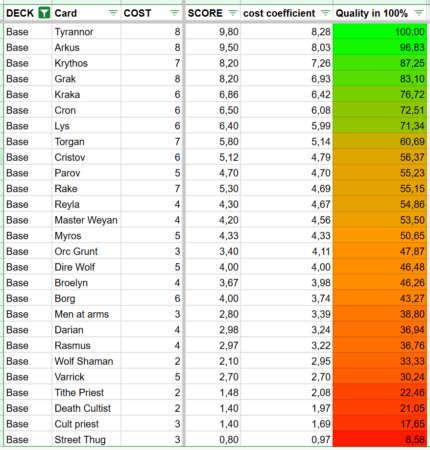
General strengths and weaknesses
The Base set has a relatively high average cost efficiency, but most of its valuable cards only appear at cost 4 or higher. The truly strong cards in this set start at cost 6, so it’s important to build a solid base economy to be able to afford them early enough.
Early vs late game performance
For the early game, higher-cost cards score better, but they only become useful from cost 4 onward (e.g., Broelyn and Rasmus). They aren’t the best cards overall, but a champion that provides 2 econ is still a decent early buy. The Sacrifice champions remain the best early-game cards, and in the Base set, these appear only from cost 6.
The late-game value of the set is decent.
Set composition (actions vs champions)
NOTE: when i talk about “total cards” this means like most 2 cost cards have 3 copies in the set. While 3 cost cards have 2 copies and anything higher only one. (there are exceptions).
The set contains 47 actions and 37 champions in TOTAL.
Action Cards Analysis (Cleric Focus)
Good Actions (actions that synergize well with cleric)
Closed Ranks – allows the cleric to deal damage (DMG). Total cards 1
Rally the Troops – gives opportunities to trigger Prepare. Total cards 1
Discard Actions (That Hurt Cleric)
Elven Curse (2)
Spark (3)
Wolf Form (1)
So this set has 7 primary discard ACTION cards. These are cards the cleric does not want to see in the market deck!
Low cost champions:
2‑Cost Champions (which synergy with Minor Resurrect and Righteous Resurrect)
The 2-cost cards are Wolf Shaman, Death Cultist, and Tithe Priest.
These are all cards you rarely buy because of their low performance and consistency.

3 to 4 cost cards ( Which synergy with Lesser Resurrect)
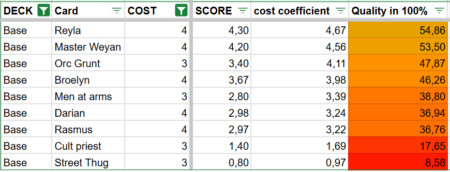
Observations:
Top cards are Reyla and Master Weyan, followed by Orc Grunt and Broelyn, with cost coefficients above 4 and quality around or above 50%. These are the best candidates for synergy with Lesser Resurrect.
Men at Arms, Darian, and Rasmus have moderate value but are less impactful.
Cult Priest and Street Thug score poorly and are not worth focusing on for resurrection strategies.
In short: when playing a Base set with Lesser Resurrect, focus on Reyla, Master Weyan, Orc Grunt, and optionally Broelyn. The 2-cost cards contribute little and don’t add much to synergy.
CONCLUSING BASE SET
Overall, I’m not a big fan of this set due to the many discard cards and the low quality of the low-cost champions.
And also their are a lot of cards (actions and champions) that a cleric just don’t want to see or buy in the market. A cleric wants to be the better deck builder and a market full of bad cards doesn’t help our game plan. Because a cleric lives or dies by the market. It doesn’t really have the tools to win a game in its base deck.
Call to arms
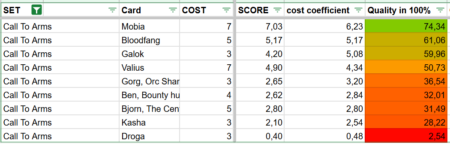
General strengths and weaknesses
Cards such as Kasha, the Awakener and Bjorn, the Centurion support a wide wall playstyle. However, this strategy can be countered by a single card in the deck: Valluis, Fire Dragon.
Call to arms has a relative low quality of champions
Galok stands out due to his Sacrifice ability and is the most valuable champion in this deck.
Mobia and Galok are the champions that really make a difference in this deck.
Valius is strong against specific decks like Necromancer, Druid, or Bard, but of course can also be used against you.
Early vs late game performance
Average performance in both the early and late game.
Best early game cards for this deck are Mobia (if you can afford it), “Galoc” en “Bloodfang”.
Best late game cards for this deck are the same cards plus “Valluis”
Deck composition (actions vs champions)
The deck contains 12 actions and 13 champions in TOTAL.
Action Cards Analysis (Cleric Focus)
Good Actions (actions that synergize well with cleric)
Afterlife (2) Devotion (2) The Summoning (1)
Discard Actions (That Hurt Cleric)
Raiding party (2)
Low cost champions:
No 2-cost cards
3 and 4 cost champions:

CONCLUSING Call to arms SET
Not really bad nor good to add. But watch out for Valius.
Might be worth considering using this set when using LESSER resurrect
DUNGEONS
General strengths and weaknesses
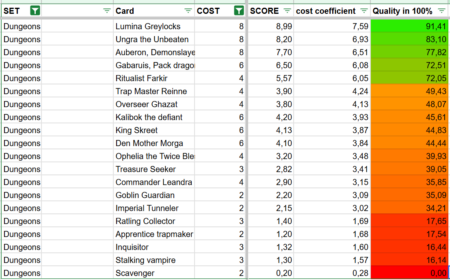
Dungeons doesn’t really have the best low-cost champions.
You can only talk about good quality starting from cost 5.
But from cost 5 onwards, the quality is genuinely strong.
Especially early on, the high-cost cards can be very effective, even though they are expensive.
These are:
Gorgar, Demon of the depths – Ritualist Farkir – Lumina Greylocks – Maximus, Guild Boss – Amarant the unfading – Roland the sun’s blade – Ungra the Unbeaten – Auberon, Demonslayer – Gemmla, Wolf scout
Dungeons has very high-quality late-game champions.
Early vs late game performance
Good but expensive early game champions.
(This can also be said about base deck, but dungeons just don’t have as many “bad cards” overall).
This deck also has some great late game value in terms of champions!
Set composition (actions vs champions)
Dungeons has 47 Actions and 40 champions in total .
Action Cards Analysis (Cleric Focus)
Good Actions (actions that synergize well with cleric)
Grave Robbery (2), Light the way (1), Prepare for Battle (1)
Discard Actions (That Hurt Cleric)
Rat Swarm (1) (this can single handedly make your opponent win the game vs your cleric).
Wild charge (1) (discard)
Low cost champions:
2‑Cost Champions (Synergy with Minor Resurrect and Righteous Resurrect)

3 to 4 cost champions ( Synergy with Lesser Resurrect)
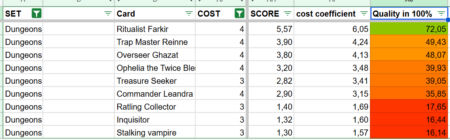
Ritualist Farkir stands out here, thanks to the ability to sacrifice from the discard pile and generate gold..
The rest aren’t particularly noteworthy.
CONCLUSING Dunguens SET
Nice sacrifice champions
Only one primary discard Actions but more discard champions.
you MUST use this deck when adding LESSER resurrect as your secondarily ability.
Just because of Ritualist Farkir. The rest of the 3 to 4 cost cards aren’t that good. but their aren’t as bad as in base deck and their are plenty.
This deck has a lot of cards with “PREPARE” in the text AND has a lot of champions that are great to prepare!
Dungeons Promo
Dungeons Promo is the recommended Queue Setup for Cleric
- At the moment, you NEED either the Base set or Dungeons promo enabled. My recommendation for Cleric: always include Dungeons promo .
- Note: Dungeons promo access is currently limited to beta players only.
General strengths and weaknesses
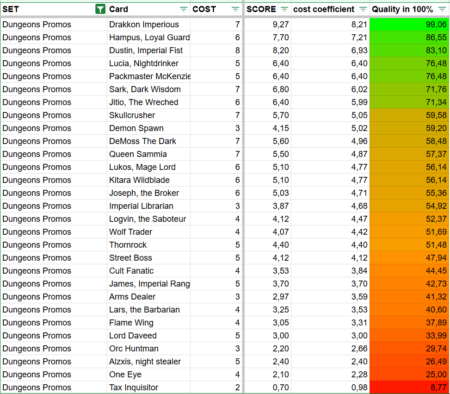
The Dungeons promo pack contains some of the strongest value picks in Hero Realms, along with several of the best low‑cost champions across all sets. Below is a concise, curated summary for gameplay and deck‑building—especially if you’re piloting the Cleric.
Top Standouts
- Drakkon Imperious scores exceptionally well in this system and is a premium pick in virtually any strategy.
- Hampus, Loyal Guardian excels when you want to build a defensive wall—great at stabilizing and protecting your board.
- Lucia, Nightdrinker offers reliable value and a useful sacrifice (sac) option at cost 5.
- Packmaster McKenzie will almost always convert into a draw for a Cleric, making it a highly consistent tempo tool.
- Sark, Dark Wisdom and Jitio, the Wretched both bring sacrifice utility to the table.
- Demon Spawn stands out for a powerful sacrifice card at just cost 3!
- DeMoss the Dark shines in the late game—its impact scales superbly as the match goes long.
Early vs late game performance
Strong Early‑Game Options:
Wolf Trader, Street Boss, Imperial Librarian, and Arms Dealer provide reliable early‑game momentum and economy, helping you curve smoothly into your mid‑game buys.
Set composition (actions vs champions)
The set contains 45 actions and 41 champions in TOTAL.
Action Cards Analysis (Cleric Focus)
Good Actions (actions that synergize well with cleric)
Two FANTASTIC actions synergize with having two or more champions in play: Troop Surge (cost 3) and War Blessing (cost 4). These can swing tempo dramatically when your board is developed.
Discard Actions (That Hurt Cleric)
The primary discard effect with strong damage in this pack is Elven Fury—there’s only one copy, but it hits hard.
There’s also lore telling (3) with primary discard effect. But lore telling also fits in cleric’s set.
The howling (2) has a secondary discard effect.
Low cost champions:
2‑Cost Champions (Synergy with Minor Resurrect and Righteous Resurrect)
This pack includes one cost‑2 champion (Tax Inquisitor).

3 to 4 cost champions ( Synergy with Lesser Resurrect)
Observations:
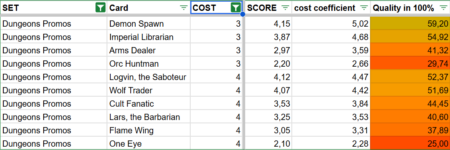
There are ten champions in the cost‑3 to cost‑4 band. Notable early pickups include Demon Spawn, Imperial Librarian, Wolf Trader, Arms Dealer, Logvin the Saboteur, and Cult Fanatic—great targets for Lesser Resurrect due to their efficiency and impact.
CONCLUSING Dungeons Promo set
I love this set and i hope this set will be available for everyone soon.
Journeys set
General strengths and weaknesses
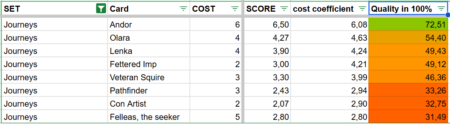
The Journeys set is relatively small and has a low average Cost Coefficient among all sets
Early vs late game performance
“Fettered Imp”, because of its 2 cost, and “Olara”, because of its economy, are good early‑game cards.
Late game: “Andor, the Valiant” its primary draw works well with other “prepare” cards. A strong late‑game card, and never a bad purchase.
Set composition (actions vs champions)
The set contains 12 actions and 14 champions in TOTAL.
Action Cards Analysis (Cleric Focus)
Good Actions (actions that synergize well with cleric)
Sway (for econ for buying champions) (2)
Actions (That Hurt Cleric)
Daring escape (discard but not a card to worry about)(2).
Demonic Cloud! (1) (board clear)
set composition:
2‑Cost Champions (Synergy with Minor Resurrect and Righteous Resurrect)

3 to 4 cost champions ( Synergy with Lesser Resurrect)

CONCLUSING Journeys SET
Not a set I would pick when using a wall strategy like Blessing of the Flock or Steel.
However, it is certainly a set worth choosing when playing against a wall‑based Necromancer.
Cards like Con Artist, Confiscate, Pathfinder, Pelleas, the Seeker, Trash, and Veteran Squire are not always the cards you want to buy, as they can bloat the market deck and/or your own deck.
Journeys Promo
General strengths and weaknesses
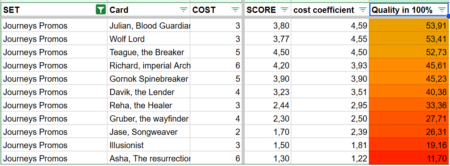
Journeys promo have a low average champion coefficient.
The advantage of this is that most of these champions only activate after you have played a champion (including the one you are playing).
This means that these champions are not very desirable for most other classes. However, for classes that have champions in their starting deck, these cards do have utility.
Early vs late game performance
“Fettered Imp”, because of its 2 cost, and “Olara”, because of its economy, are good early‑game cards.
Late game: “Andor, the Valiant” its primary draw works well with other prepare cards. A strong late‑game card, and never a bad purchase.
set composition (actions vs champions)
The set contains 12 actions and 17 champions in TOTAL.
Action Cards Analysis (Cleric Focus)
Discard Actions (That Hurt Cleric)
Elven Fury
Set composition:
This set contains two different 2-cost champions (six cards in total) and four champions in the 3–4 cost range (six cards in total).
2‑Cost Champions (Synergy with Minor Resurrect and Righteous Resurrect)

3 to 4 cost champions ( Synergy with Lesser Resurrect)

Observations:
Perfect for when playing with Lesser Resurrect.
CONCLUSING Journeys Promo SET
You can buy actions like “Battle Fire” first (if possible) and wait a turn to buy the champions on the following turn, knowing that your opponent will probably not want them.
These champions have relatively high defense for their cost.
I would always include this set when playing Cleric, especially when using Bless of Flock or Bless of Steel.
Prepare to prepare!!
I also included a short analysis of which decks contain the strongest cards for the Prepare mechanic.
Base
Mix of low, medium, high, and extreme Prepare cards
Large variation in Prepare strength
Call To Arms
Mostly low to medium Prepare
Very consistent Prepare levels
No extreme Prepare effects
Dungeons
Full spectrum from low to extreme Prepare
High variance in Prepare strength
Includes several high-impact Prepare cards
Dungeons promo
Mostly medium to high Prepare
Contains some extreme Prepare cards
Journeys
Mostly medium Prepare
Very balanced distribution
Few very low or very high Prepare effects
Journeys promo
Mostly low to medium Prepare
Narrow range of Prepare effects
Lower overall Prepare strength
If this doesn’t tell you much, don’t worry — it didn’t mean much to me at first either. The key takeaway, however, is that Dungeons is the best set when it comes to the Prepare mechanic. Not only does it include several strong champions that benefit from preparing, it also features cards like Prepare for Battle. Of course, the set also includes powerful champions such as “Roland the Sun’s Blade” and “Merriglow the Minstrel”.
My conclusion
After reviewing this data.
I decided to play my classic cleric build (minor resurrect + devine resurrect), with:
Dungeons , Dungeons promo, Journey Promo
Im no data analist, but i dit my best and i hope you enjoyed this article.
I used alot of AI for this but it wasn’t always that usefull.
Ayways I lets gave AI this article in combination with my data and IT come up with this compulation:
(It doesn’t agree with me 100% but i tought I’ll add it anyways
AI's compulation
After combining both the data-driven results and the practical gameplay observations, a clearer
picture emerges of how each set performs in Hero Realms. While the numerical model highlights
efficiency and value, the real strength of each set only becomes fully visible when you consider
deckbuilding impact, synergy, and playstyle (especially Cleric).
Overall Set Comparison
Top Tier (Best Overall Value & Impact)
Dungeons Promos, Base Set, Dungeons
Dungeons Promos stands out as the strongest overall set, with the highest efficiency and excellent
early- and late-game options. It also contains some of the best low-cost champions in the game,
making it extremely consistent.
Base Set performs well statistically, but relies heavily on higher-cost champions. Its power is real,
but slower to access.
Dungeons is slightly more consistent than Base, with fewer weak cards and strong late-game
champions.
Mid Tier (Situational but Playable)
Journeys
Journeys has a lower average efficiency, but still offers useful niche tools. It performs better in the
late game and contains valuable synergy cards, but can clutter the market deck.
Low Tier (Below Average Efficiency)
Call to Arms, Journeys Promos
Call to Arms has low overall efficiency but a few standout champions. Journeys Promos scores
lowest but has strategic value, especially for Cleric.
Final Conclusion
Best overall set: Dungeons Promos
Most reliable core sets: Dungeons and Base
Best synergy (Cleric): Dungeons + Dungeons Promos + Journeys Promos
Final Thought
Numbers alone don’t tell the full story. A set with lower efficiency can still be powerful if it improves
the market, fits your strategy, or is ignored by opponents.
And that’s it — I finally finished this article. Ha!
But what about Bard, I hear you ask?
Here’s a link to the datasheet I made. Feel free to explore it and have fun!
https://docs.google.com/spreadsheets/d/1NxLUepk5oJIgvIpT_d8dsvr4CC4OuKVwOsw0ddUODfI/edit?usp=sharing
Why are you looking at me like that…?
No! I’m done! I mean it! I… oh, alright, one more thing…
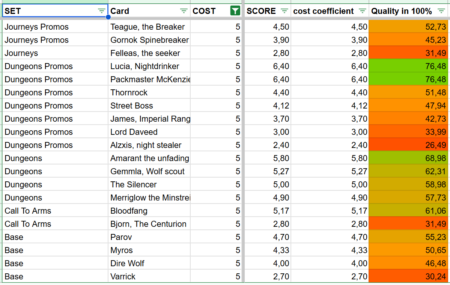
Bard, 5 cost champions
Oke bard has some abilities that say “ a champion up to cost 5 or less”.
So just use Dungeons and dungeon promo, and maybe base set:
Dungeons, Dungeons promo and Base
Title: Sets and Champions: A Cleric’s Perspective
Category: Cleric
Tags:
Published on: March 11, 2026
From Belgium and works as an automation specialist. Was first introduced by a friend to a physical copy of Star Realms, from there finding his way to the digital App. After chancing on Hero Realms through the Star Realms App he was instantly hooked! But soon discovered there was a lot too learn. Perusing the likes of the Realms Rising website and podcast led him to the wonderful community found only in the Realms Rising Discord. A 'Cleric'al error or two may be found in the article, only natural with the talent he wields.
